At a glance
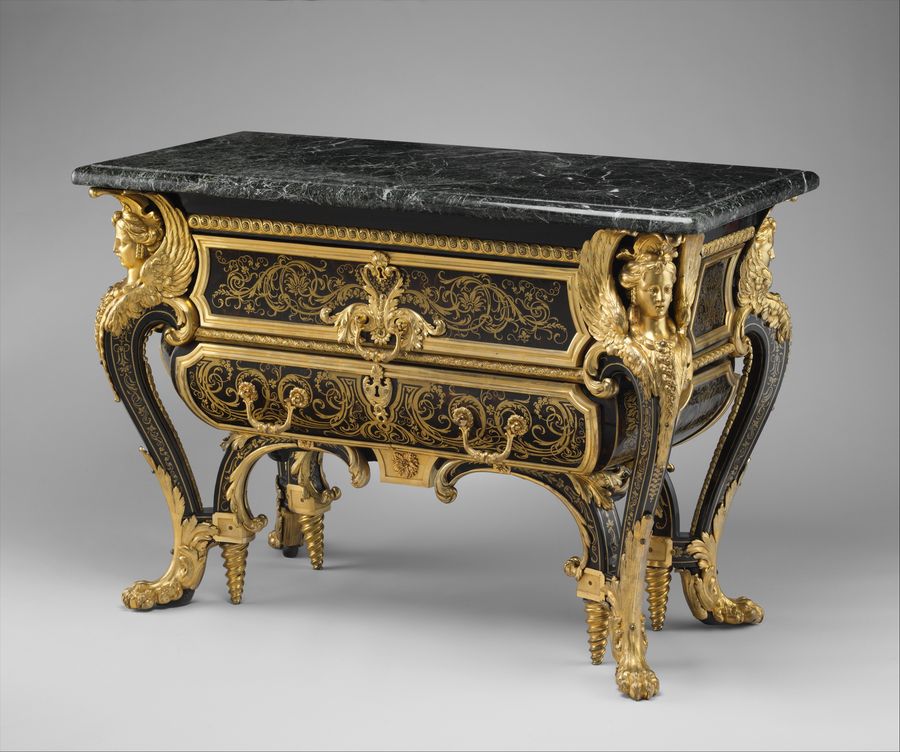
The Louis XIV style (c. 1660 to 1715) expresses the majesty of the Sun King: symmetry, monumental scale, carved and gilded wood, tortoiseshell and brass Boulle marquetry, and gilt-bronze mounts. Driven by Colbert and the painter Charles Le Brun, the Gobelins manufactory defined a court art imitated throughout Europe.
- Period
- 1660 – 1715
- Line
- Symmetrical, monumental
- Ornament
- Sunburst, acanthus, mascarons
- Woods
- Giltwood, ebony, tortoiseshell
Context
In 1661, Louis XIV began to rule alone. Colbert marshalled the arts in the service of royal prestige: the Gobelins manufactory, acquired in 1662, became in 1667 the Manufacture royale des meubles de la Couronne, directed by Le Brun. Cabinetmakers, sculptors, bronze casters and tapestry weavers worked there side by side for the Louvre and later Versailles. Furniture became an instrument of power.
Timeline
- 1661Louis XIV begins his personal rule.
- 1662Colbert acquires the Gobelins for the Crown.
- 1667Founding of the Manufacture royale des meubles de la Couronne, directed by Le Brun.
- 1672André-Charles Boulle is granted lodgings at the Louvre as cabinetmaker to the King.
- 1682The court settles at Versailles.
- 1715Death of Louis XIV.
How to recognise the Louis XIV style
- Perfect symmetry — in both silhouette and decoration.
- Baluster, tapering or scroll legs — joined by X- or H-shaped stretchers.
- Carved and gilded wood — for consoles, guéridons, seating and frames.
- Boulle marquetry — of tortoiseshell, brass and pewter, in ‘première partie’ and ‘contre-partie’.
- Gilt-bronze mounts — mascarons, masks, sabots, escutcheons.
- Royal motifs — the sun, fleurs-de-lis, acanthus leaves, lambrequins, symmetrical shells.
- High, rectangular-backed armchairs — scrolled arm supports, upholstered in velvet or tapestry.
Signature pieces: eight-legged bureau Mazarin, cabinet, wall-mounted console table, guéridon candlestand, Boulle armoire and, around 1700, the first commodes.
The Louis XIV style and its neighbours
| Feature | Louis XIII | Louis XIV | Régence |
|---|---|---|---|
| Period | 1610 – 1660 | 1660 – 1715 | 1715 – 1730 |
| Line | Straight, massive | Symmetrical, monumental | Symmetrical curves |
| Legs | Turned, joined by stretchers | Baluster, tapering gaine | Cabriole, with hoof feet (‘pied de biche’) |
| Ornament | Turning, diamond-point carving | Sunburst, acanthus, mascarons | Shells, espagnolettes |
| Woods | Walnut, oak, ebony | Giltwood, ebony, tortoiseshell | Kingwood, satinwood, walnut |
Louis XIV furniture is recognisable by its rigorous symmetry, straight legs joined by stretchers and ceremonial decoration. The Régence that follows retains the symmetry but introduces the cabriole leg and lightens the forms. Beware: Boulle marquetry enjoyed major revivals under Louis XVI and again under Napoléon III; many ‘Boulle’ pieces date from the 19th century.
The Great Names
- André-Charles Boulle (1642 – 1732), cabinetmaker to the King and master of tortoiseshell and brass marquetry.
- Pierre Golle (c. 1620 – 1684), cabinetmaker to Mazarin and later to the King.
- Domenico Cucci (c. 1635 – 1705), cabinetmaker and bronze caster at the Gobelins.
Frequently asked questions
What is Boulle marquetry?
How to date Boulle furniture
Is Louis XIV furniture stamped?
Sources: Guillaume Janneau, Les Styles du meuble français, PUF, ‘Que sais-je?’ series · Musée des Arts décoratifs, Paris — permanent collections · Musée du Louvre, Department of Decorative Arts · Mobilier national.