At a glance
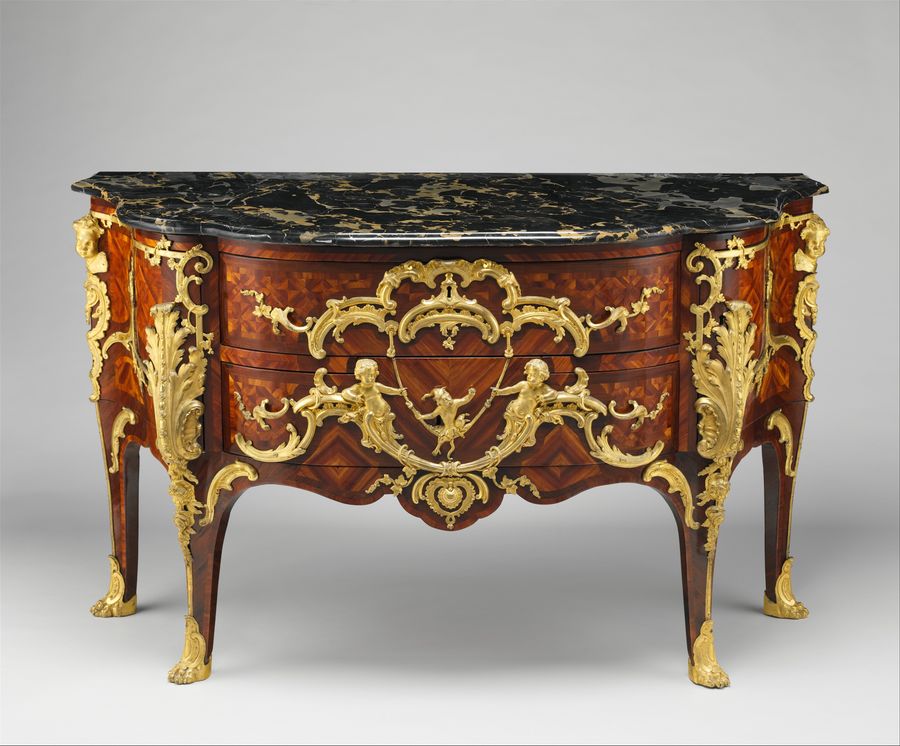
The Régence style (c. 1700 to 1730) bridges the majesty of Louis XIV and the fantasy of Louis XV. Forms soften: the cabriole leg, bombé fronts and the pierced shell appear, while symmetry is retained. It takes its name from the regency of Philippe d'Orléans (1715–1723).
- Period
- 1715 – 1730
- Line
- Symmetrical curves
- Ornament
- Shells, espagnolettes
- Woods
- Kingwood, satinwood, walnut
Context
On the death of Louis XIV, the court left Versailles for Paris. The Regent, Philippe d'Orléans, and Parisian society sought more intimate and comfortable interiors. The ornamental designers Gillot and Watteau popularised a light decorative vocabulary: arabesques, singeries and chinoiseries. Furniture grew more supple without abandoning classical balance.
Timeline
- 1715Death of Louis XIV; regency of Philippe d'Orléans, and the court leaves Versailles for Paris.
- 1719Charles Cressent works for the Regent.
- 1723Death of the Regent; Louis XV comes of age.
- c. 1730Rocaille decoration prevails: the birth of the Louis XV style.
Recognising the Régence style
- Cabriole legs — known as 'pied de biche' (doe's foot), often without stretchers.
- Bombé fronts — 'tombeau' or 'arbalète' (crossbow-shaped) commodes.
- Symmetry retained — the key difference from Louis XV.
- Pierced shells — palmettes, trelliswork, dragons and singeries.
- Espagnolettes — gilt-bronze female busts on the corners of commodes and desks.
- Kingwood veneer — laid in butterfly-wing or frisage patterns.
- Flat-backed armchairs — gently shaped, with set-back arms.
Signature pieces: three-drawer commode en tombeau, bureau plat, wall cartel clock, carved console table, flat-backed armchair.
The Régence style and its neighbours
| Feature | Louis XIV | Régence | Louis XV |
|---|---|---|---|
| Period | 1660 – 1715 | 1715 – 1730 | 1730 – 1770 |
| Line | Symmetrical, monumental | Symmetrical curves | Curved, asymmetrical |
| Legs | Baluster, tapering gaine | Cabriole, with hoof feet (‘pied de biche’) | Cabriole, with hoof feet |
| Ornament | Sunburst, acanthus, mascarons | Shells, espagnolettes | Rocaille, flowers |
| Woods | Giltwood, ebony, tortoiseshell | Kingwood, satinwood, walnut | Tulipwood, kingwood, walnut |
A Régence commode and a Louis XV commode look alike: look at the symmetry. Régence keeps a centred, balanced decoration (a shell in the middle), whereas Louis XV ventures into rocaille asymmetry. Régence commodes often have three tiers of drawers separated by dividing rails; Louis XV prefers two drawers 'sans traverse', with no visible rail.
The Great Names
- Charles Cressent (1685 – 1768), cabinetmaker to the Regent, sculptor and bronze-caster.
- Étienne Doirat (c. 1675 – 1732), maker of commodes with vigorous gilt-bronze mounts.
- Antoine-Robert Gaudreaus (c. 1682 – 1746), cabinetmaker to the King.
Frequently asked questions
Why does the Régence style extend beyond the political regency?
What is an espagnolette?
How do you recognise a Régence mirror?
Sources: Guillaume Janneau, Les Styles du meuble français, PUF, ‘Que sais-je?’ series · Musée des Arts décoratifs, Paris — permanent collections · Musée du Louvre, Department of Decorative Arts · Mobilier national.