At a glance
The Louis XV style, or rocaille style, is the French decorative style of the 1730s to 1770. It is recognisable by its curving lines, its asymmetrical ornament inspired by shells and plant forms, and its cabriole legs. Parisian pieces of the period often bear the stamp of their maker, compulsory from 1743.
- Period
- 1730 – 1770
- Line
- Curved, bombé
- Ornament
- Rocaille, flowers
- Woods
- Tulipwood, kingwood, walnut
Timeline
- 1715Death of Louis XIV. The Régence softens the forms of the Grand Siècle.
- 1730Rocaille decoration takes hold (Meissonnier, Pineau). The Louis XV style is born.
- 1743The stamp becomes compulsory for Parisian master joiners and cabinetmakers.
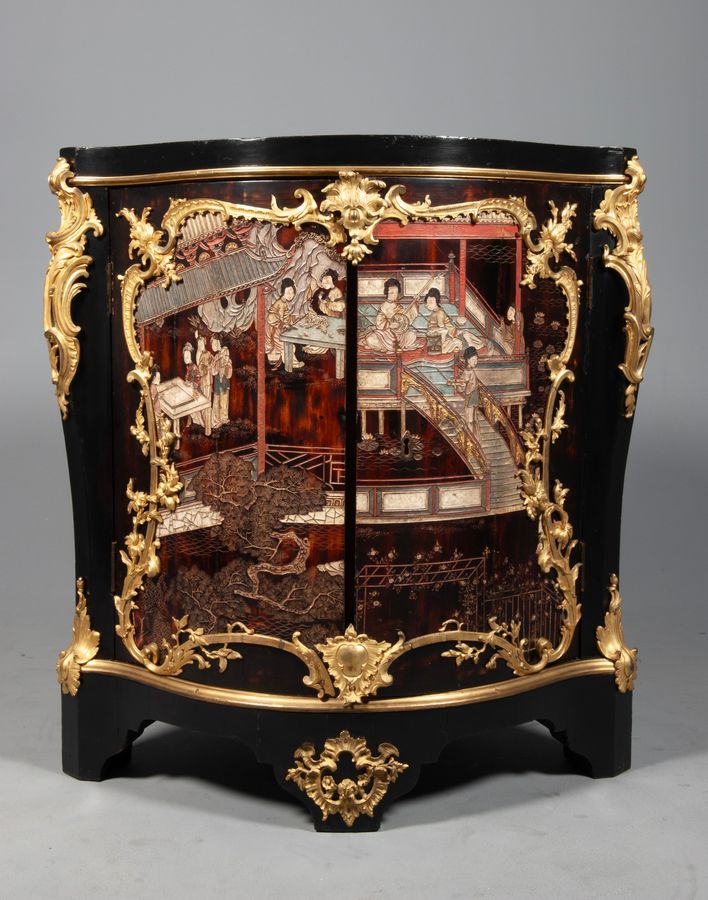
- 1750The high point: commodes ‘sans traverse’, floral marquetry, Far Eastern lacquer.
- 1760A return to antiquity after the excavations at Herculaneum: the Transition style begins.
Recognising Louis XV furniture: the 7 key features
- Cabriole legs in an S-curve, ending in a bronze sabot or a scroll.
- Bombé front and sides, ‘en arbalète’ (crossbow-shaped) or ‘en tombeau’.
- No straight lines: shaped rails and serpentine aprons.
- Asymmetrical rocaille decoration: shells, foliage, cartouches.
- Floral or trellis marquetry in tulipwood and kingwood.
- Fire-gilt bronze mounts accentuating the curves (chutes, escutcheons, sabots).
- Maker's stamp and JME mark on Parisian pieces after 1743.
Régence, Louis XV, Louis XVI compared
| Feature | Régence | Louis XV | Louis XVI |
|---|---|---|---|
| Dates | 1715–1730 | 1730–1770 | 1770–1790 |
| Line | Symmetrical curves | Curved, asymmetrical | Straight, symmetrical |
| Legs | Cabriole, restrained | Cabriole, sabots | Tapering, fluted |
| Ornament | Central shell, espagnolettes | Rocaille, flowers | Beading, ribbons, trophies |
The great Louis XV cabinetmakers
- Jean-François Oeben (1721–1763), cabinetmaker to the king, master of mechanical furniture.
- Bernard II Van Risenburgh (BVRB, c. 1700–1766), virtuoso of lacquer and floral marquetry.
- Jacques Dubois (1694–1763), lacquer commodes with exuberant gilt-bronze mounts.
- Jean-Pierre Latz (c. 1691–1754), exceptional bronzes and marquetry.
Frequently asked questions
What are the dates of the Louis XV style?
The Louis XV style flourished from around 1730 to 1770. It followed the Régence style (1715–1730) and preceded the Transition style (1760–1775), then Louis XVI.
How can you tell Louis XV from Louis XVI?
Louis XV favours the curve: cabriole legs, bombé fronts, asymmetrical rocaille ornament. Louis XVI returns to the straight line inspired by antiquity: tapering fluted legs, friezes of beading and heart-and-dart, symmetry.
Is ‘Louis XV style’ furniture antique?
Not necessarily. ‘In the Louis XV style’ refers to a copy or reinterpretation, often from the 19th century. ‘Period Louis XV’ refers to a piece made between 1730 and 1770. On Anticaria, the dealer must state this distinction in the listing.
Sources: Pierre Kjellberg, Le Mobilier français du XVIIIe siècle, 2002 · Musée des Arts décoratifs, 18th-century collections · Wallace Collection, catalogue of French furniture · Anticaria Price Observatory, 2024–2026 data.