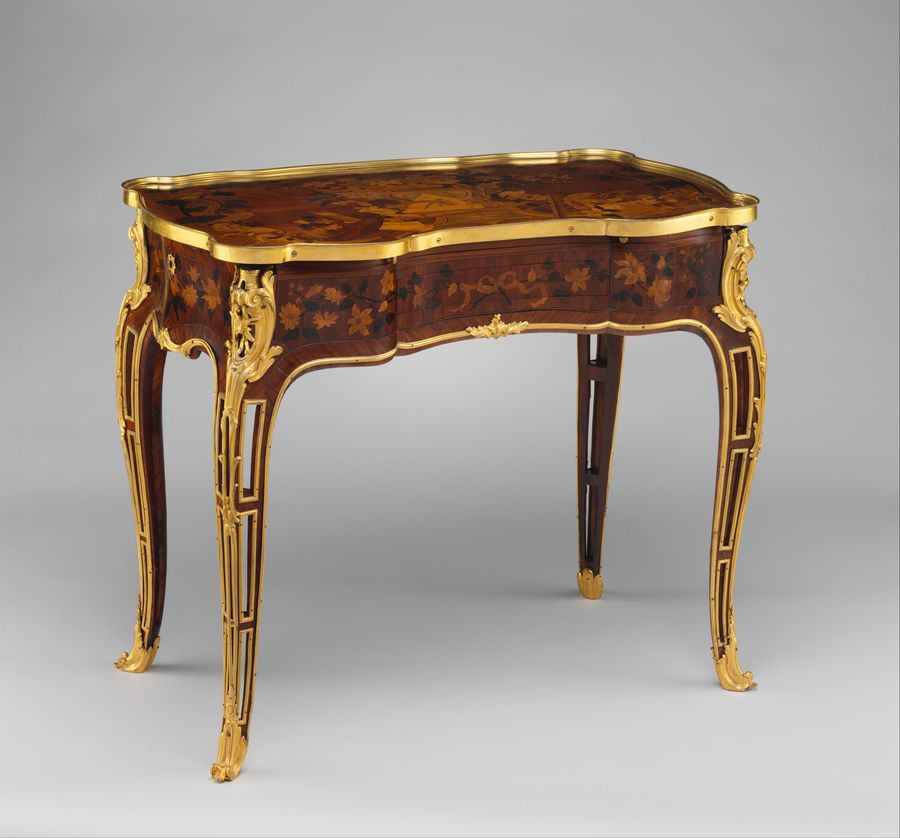
At a glance
The Transition style (c. 1760 to 1775) pairs the still-curved silhouette of Louis XV with the neoclassical ornament of the coming Louis XVI style: Greek key, Vitruvian scroll, interlacing, laurel garlands. It grew out of the Parisian « goût grec », fuelled by the excavations at Herculaneum and Pompeii.
- Period
- 1760 – 1775
- Line
- Gentle curves, crisp corners
- Ornament
- Greek key, Vitruvian scroll, interlacing
- Woods
- Tulipwood, amaranth, sycamore
Context
In the mid-18th century, the discoveries at Herculaneum and Pompeii, followed by the publications of the Comte de Caylus, sparked a reaction against rocaille exuberance. Parisian connoisseurs embraced the « goût grec ». Cabinetmakers at first kept the curved forms their clientele was used to, but dressed them in antique ornament: this was the Transition.
Timeline
- 1738Excavations begin at Herculaneum.
- 1748Excavations begin at Pompeii.
- 1752First volume of the Comte de Caylus's Recueil d'antiquités.
- 1756–1757Furniture « à la grecque » designed by Le Lorrain for Lalive de Jully.
- 1774Accession of Louis XVI: Neoclassicism triumphs.
How to recognise the Transition style
- A still-curved silhouette — but a softened curve, with crisper corners.
- Breakfront façades — with straighter aprons.
- Gently cabriole legs — or already straight, sometimes on the same piece.
- Geometric marquetry — cube parquetry, lozenges, ribbons or antique-style urns.
- Neoclassical mounts — Greek key, Vitruvian scroll, beading, water leaves, laurel garlands.
- A blend of two idioms — on a single piece: this is its hallmark.
Signature pieces: breakfront commode, roll-top desk, fall-front secretaire, writing table, chiffonnier.
The Transition style and its neighbours
| Feature | Louis XV | Transition | Louis XVI |
|---|---|---|---|
| Period | 1730 – 1770 | 1760 – 1775 | 1770 – 1790 |
| Line | Curved, asymmetrical | Gentle curves, crisp corners | Straight, symmetrical |
| Legs | Cabriole, with hoof feet | Gently cabriole | Tapering, fluted |
| Ornament | Rocaille, flowers | Greek key, Vitruvian scroll, interlacing | Beading, ribbons, trophies |
| Woods | Tulipwood, kingwood, walnut | Tulipwood, amaranth, sycamore | Mahogany, tulipwood, satinwood |
A Transition piece is recognised by the deliberate tension between form and ornament: a Louis XV curve with Louis XVI decoration. If the line is entirely straight and the legs tapered, it is Louis XVI; if the decoration remains rocaille and asymmetrical, it is Louis XV.
The Great Names
- Jean-François Oeben (1721 – 1763), cabinetmaker to the king and forerunner of the Transition style.
- Roger Vandercruse, known as Lacroix (1727 – 1799), stamped RVLC.
- Pierre Garnier (c. 1726 – 1806), among the first cabinetmakers to embrace the goût grec.
- Jean-François Leleu (1729 – 1807), pupil of Oeben.
Frequently asked questions
Is Transition a true style?
What is the « goût grec »?
Sources: Guillaume Janneau, Les Styles du meuble français, PUF, ‘Que sais-je?’ series · Musée des Arts décoratifs, Paris — permanent collections · Musée du Louvre, Department of Decorative Arts · Mobilier national.