At a glance
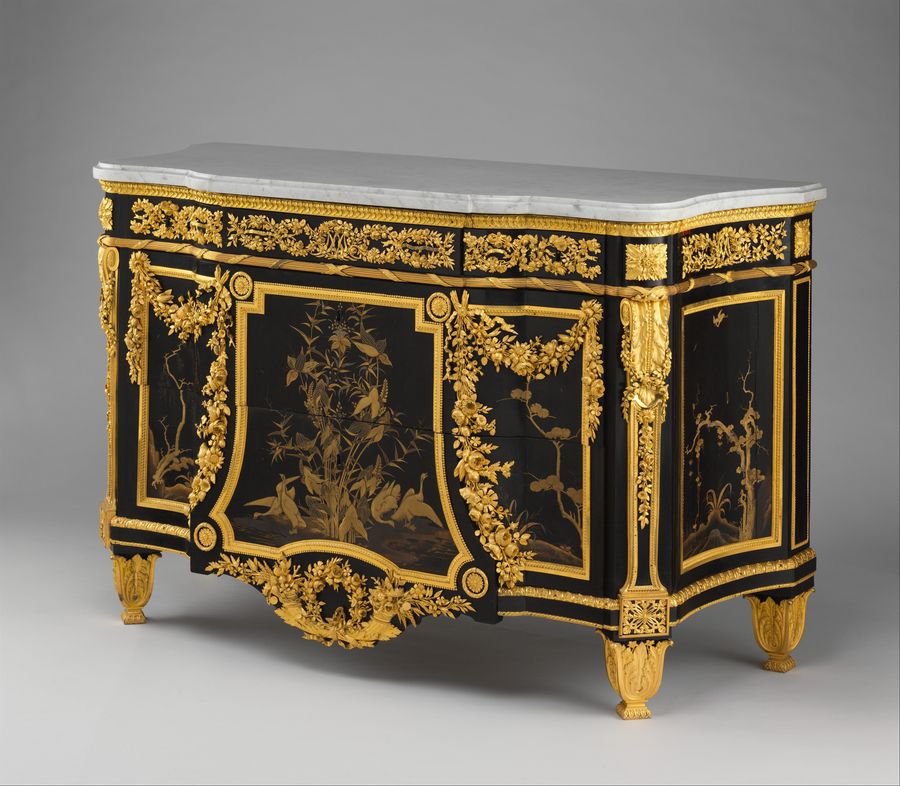
The Louis XVI style (c. 1770 to 1790) returns to the straight line and to a symmetry inspired by antiquity: tapering, fluted legs, friezes of beading and heart-and-dart, ribbons, trophies and garlands. Parisian cabinetmaking reached its technical zenith, with Riesener, Weisweiler and Carlin.
- Period
- 1770 – 1790
- Line
- Straight, symmetrical
- Ornament
- Beading, ribbons, trophies
- Woods
- Mahogany, tulipwood, satinwood
Context
Neoclassicism, already present in the goût grec, came fully into its own with the accession of Louis XVI in 1774. Marie-Antoinette commissioned exquisite furniture for Versailles, the Trianon, Saint-Cloud and Fontainebleau. Anglomania made solid mahogany fashionable, while the marchands-merciers had Sèvres porcelain plaques mounted on small pieces of furniture.
Timeline
- 1769Riesener delivers Louis XV’s cylinder desk, begun by Oeben.
- 1774Accession of Louis XVI; Riesener becomes cabinetmaker-in-ordinary to the Crown.
- 1787Georges Jacob delivers the “Etruscan” chairs for the Rambouillet dairy.
- 1791Guilds abolished: the stamp is no longer compulsory.
How to recognise the Louis XVI style
- Straight lines and symmetry — in silhouette and decoration alike.
- Tapering legs — fluted or stop-fluted, ending in toupie feet.
- Corner blocks — carved with a rosette, where the legs meet the apron.
- Friezes — of beading, egg-and-dart, heart-and-dart or acanthus leaves.
- Classical motifs — ribbons, bows, laurel garlands, trophies, medallions, urns.
- Geometric marquetry — or Sèvres porcelain plaques.
- Seating — with medallion, cocked-hat (chapeau de gendarme) or rectangular backs.
Signature pieces: breakfront commode, roll-top desk, bonheur-du-jour, fall-front secretaire, console desserte, medallion-back armchair, bergère.
The Louis XVI style and its neighbours
| Feature | Transition | Louis XVI | Directoire |
|---|---|---|---|
| Period | 1760 – 1775 | 1770 – 1790 | 1789 – 1804 |
| Line | Gentle curves, crisp corners | Straight, symmetrical | Straight, pared-back |
| Legs | Gently cabriole | Tapering, fluted | Sabre or tapering |
| Ornament | Greek key, Vitruvian scroll, interlacing | Beading, ribbons, trophies | Palmettes, lozenges, stars |
| Woods | Tulipwood, amaranth, sycamore | Mahogany, tulipwood, satinwood | Mahogany, fruitwoods |
Louis XVI differs from the Transition style in its complete abandonment of curves, and from Directoire in its richer ornament (gilt-bronze mounts, friezes, marquetry). Beware: the Louis XVI style was widely copied under Napoléon III, as Empress Eugénie revered Marie-Antoinette. 19th-century copies have machine-sawn carcasses and softer, less crisply chased mounts.
The Great Names
- Jean-Henri Riesener (1734 – 1806), cabinetmaker-in-ordinary to the French Crown.
- Georges Jacob (1739 – 1814), chair maker to Marie-Antoinette.
- Adam Weisweiler (1744 – 1820), cabinetmaker of precious small furniture.
- Martin Carlin (c. 1730 – 1785), furniture mounted with Sèvres plaques.
- Jean-Baptiste-Claude Sené (1748 – 1803), chair maker.
- Pierre Gouthière (1732 – 1813), chaser and gilder.
Frequently asked questions
What is a medallion-back armchair?
How can you recognise a period Louis XVI commode?
Why are some Louis XVI pieces made of mahogany?
Sources: Guillaume Janneau, Les Styles du meuble français, PUF, ‘Que sais-je?’ series · Musée des Arts décoratifs, Paris — permanent collections · Musée du Louvre, Department of Decorative Arts · Mobilier national.