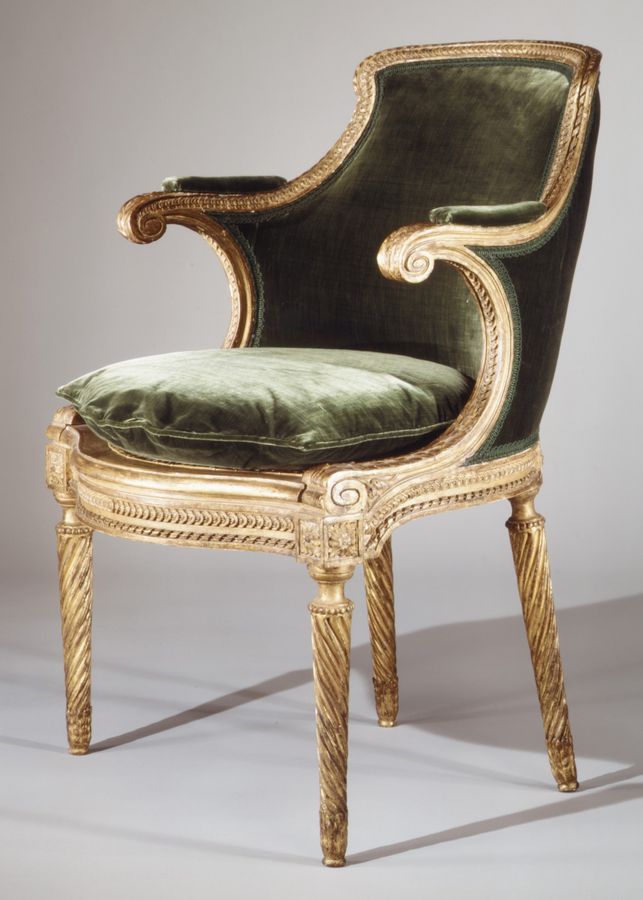
At a glance
The Directoire style (c. 1789 to 1804) pared back Louis XVI neoclassicism after the Revolution: stricter classical forms, sparing ornament and solid mahogany. Seat furniture, inspired by the Greek klismos, adopted rolled-over backs and sabre legs. It heralded the Empire style.
- Period
- 1789 – 1804
- Line
- Straight, pared-back
- Ornament
- Palmettes, lozenges, stars
- Woods
- Mahogany, fruitwoods
Context
The Revolution abolished the guilds in 1791: stamping was no longer compulsory and the great royal commissions vanished. Workshops adapted to a new clientele with more modest means. The architects Percier and Fontaine and the Jacob brothers established a vocabulary drawn directly from ancient vases and bas-reliefs.
Timeline
- 1791Guilds abolished: the stamp is no longer compulsory.
- 1795The Directoire is established.
- 1796Georges Jacob's sons found Jacob frères.
- 1799Bonaparte's coup d'état: the Consulat (Consulat style, 1799–1804).
- 1804Proclamation of the Empire.
How to Recognise the Directoire Style
- Rolled-over backs — scrolled or gondola-shaped, inspired by the Greek klismos.
- Sabre legs — at the back, with turned spindle or sabre legs at the front.
- Restrained ornament — stringing, lozenges, stars, palmettes.
- Classical motifs — lyres, sphinxes, emerging swans and, more rarely, revolutionary emblems.
- Solid mahogany — and veneer, with little marquetry.
- Inlay — of brass or light-wood stringing.
Signature pieces: scroll-back chair, gondola armchair, bed « à la romaine », upright secretaire, guéridon, console table.
The Directoire style and its neighbours
| Feature | Louis XVI | Directoire | Empire |
|---|---|---|---|
| Period | 1770 – 1790 | 1789 – 1804 | 1804 – 1815 |
| Line | Straight, symmetrical | Straight, pared-back | Massive, cubic |
| Legs | Tapering, fluted | Sabre or tapering | Lion’s-paw feet, toupie feet |
| Ornament | Beading, ribbons, trophies | Palmettes, lozenges, stars | Swans, Victories, palmettes |
| Woods | Mahogany, tulipwood, satinwood | Mahogany, fruitwoods | Flame mahogany, burr wood |
Directoire is more restrained than Louis XVI (fewer mounts, more mahogany) and lighter than Empire (less massive, with sparse mounts). Historians sometimes identify a Consulat style (1799–1804), in which the Egyptian motifs brought back from the Egyptian campaign already appear.
The Great Names
- Georges Jacob (1739 – 1814), chair maker, followed by the family workshop.
- Jacob Frères (1796 – 1803), Georges II and François-Honoré Jacob.
- Charles Percier and Pierre Fontaine (1764 – 1838 and 1762 – 1853), architect-decorators.
Frequently asked questions
Why is Directoire furniture rarely stamped?
What is a “gondola” back?
Sources: Guillaume Janneau, Les Styles du meuble français, PUF, ‘Que sais-je?’ series · Musée des Arts décoratifs, Paris — permanent collections · Musée du Louvre, Department of Decorative Arts · Mobilier national.