At a glance
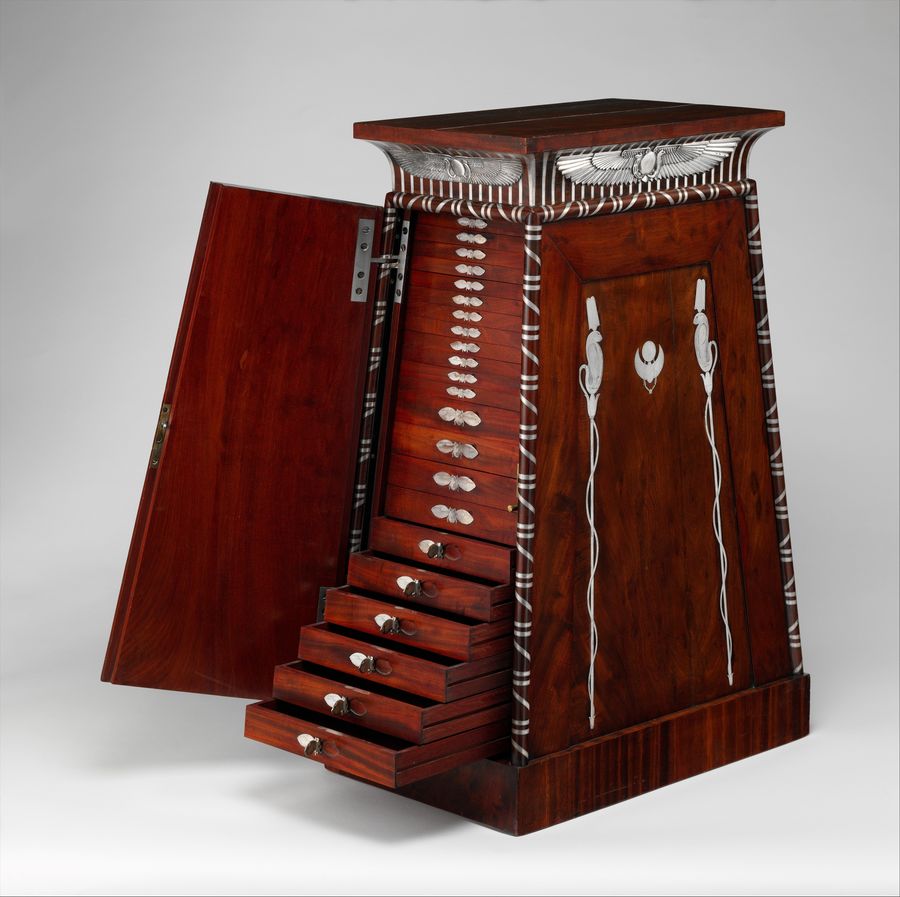
The Empire style (1804 to 1815) was the official style of the reign of Napoleon I: massive, symmetrical forms, flame mahogany, gilt-bronze mounts applied to broad flat surfaces, and antique and Egyptian motifs (swans, winged victories, sphinxes, eagles, bees). The architects Percier and Fontaine established its vocabulary.
- Period
- 1804 – 1815
- Line
- Massive, cubic
- Ornament
- Swans, Victories, palmettes
- Woods
- Flame mahogany, burr wood
Context
Napoleon turned furniture into an instrument of propaganda. The imperial palaces (the Tuileries, Saint-Cloud, Fontainebleau, Compiègne) were refurnished by the Garde-Meuble. Percier and Fontaine published their Recueil de décorations intérieures, which circulated throughout Europe. The bronziers, led by Thomire, produced ornaments of exceptional quality.
Timeline
- 1798–1801Egyptian campaign: the birth of the Egyptian taste.
- 1801Percier and Fontaine begin publishing their Recueil de décorations intérieures.
- 1804Coronation of Napoleon I.
- 1806Continental Blockade: mahogany becomes scarce.
- 1815Waterloo and the fall of the Empire.
How to Recognise the Empire Style
- Massive, cubic forms — with strict symmetry.
- Flame mahogany — or burr mahogany, in broad, smooth surfaces.
- Applied gilt-bronze mounts — set on flat surfaces rather than following the contours.
- Free-standing columns — or terminal pilasters topped with Egyptian heads.
- Feet — lion's-paw or claw, or toupie feet.
- Motifs — swans, winged victories, sphinxes, eagles, bees, laurel wreaths, palmettes.
- Seat furniture — flat, square backs, with scrolled or sphinx-head armrests.
Signature pieces: sleigh bed, cheval mirror, somno bedside table, athénienne, columned console table, upright secretaire, marble-topped guéridon, méridienne.
The Empire Style and Its Neighbours
| Feature | Directoire | Empire | Restauration |
|---|---|---|---|
| Period | 1789 – 1804 | 1804 – 1815 | 1815 – 1830 |
| Line | Straight, pared-back | Massive, cubic | Softened, rounded |
| Legs | Sabre or tapering | Lion’s-paw feet, toupie feet | Hocked or scroll legs |
| Ornament | Palmettes, lozenges, stars | Swans, Victories, palmettes | Inlaid rosettes and palmettes |
| Woods | Mahogany, fruitwoods | Flame mahogany, burr wood | Maple, lemonwood, ash |
Empire differs from the Directoire in its massiveness and profusion of gilt bronzes, and from the Restauration in its dark woods (mahogany), whereas the Restauration favoured pale woods. Beware: the Empire style was widely copied in the 19th and 20th centuries; period bronzes are chased and mercury-gilt, while copies are often cast without finishing and electroplated.
The Great Names
- Jacob-Desmalter (1770 – 1841), cabinetmaker to the Emperor, son of Georges Jacob.
- Pierre-Philippe Thomire (1751 – 1843), bronze maker.
- Martin-Guillaume Biennais (1764 – 1843), goldsmith and fine-wares maker to the Emperor.
- Charles Percier and Pierre Fontaine (1764 – 1838 and 1762 – 1853), the Emperor's architects.
Frequently asked questions
How can you recognise a period Empire bronze?
Why are there Egyptian motifs on Empire furniture?
What is a somno?
Sources: Guillaume Janneau, Les Styles du meuble français, PUF, ‘Que sais-je?’ series · Musée des Arts décoratifs, Paris — permanent collections · Musée du Louvre, Department of Decorative Arts · Mobilier national.