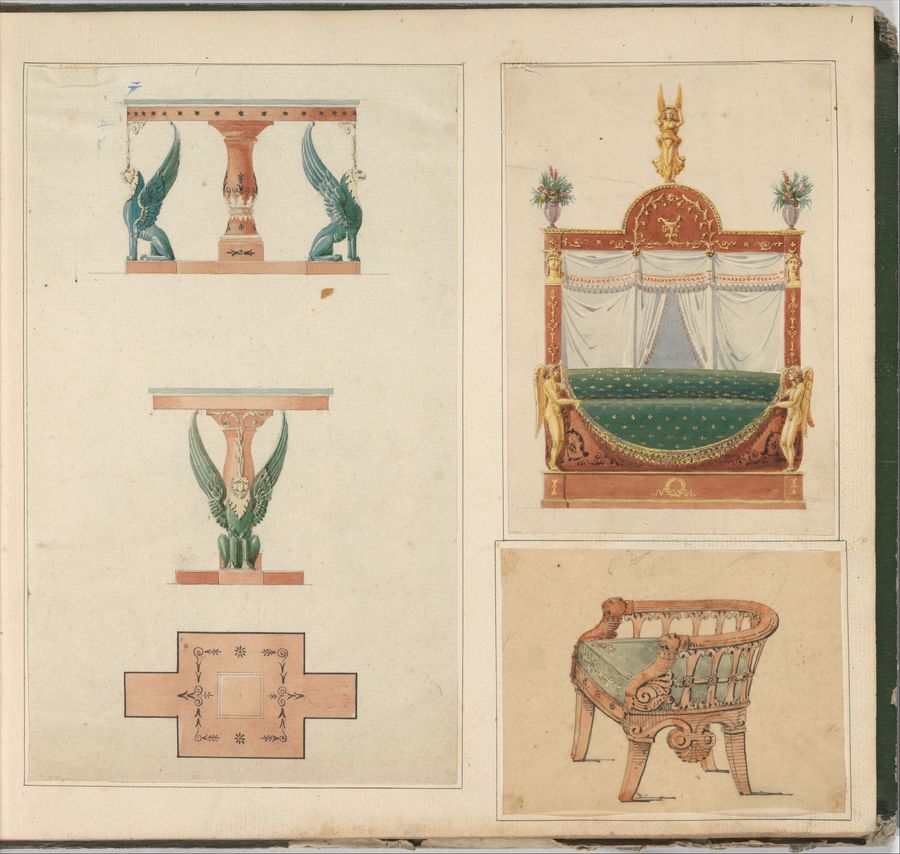
At a glance
The Restauration style (1815 to 1830) softened the Empire: rounded, lighter forms, pale woods (maple, lemonwood, ash, elm) enhanced with dark-wood marquetry, and fewer bronzes. It spans the reigns of Louis XVIII and Charles X, the latter sometimes distinguished as a ‘Charles X’ style.
- Period
- 1815 – 1830
- Line
- Softened, rounded
- Ornament
- Inlaid rosettes and palmettes
- Woods
- Maple, lemonwood, ash
Context
The return of the Bourbons did not bring a return to Ancien Régime styles: Empire forms endured, but softened. The scarcity of mahogany since the Continental Blockade, together with the taste of the day, favoured pale native woods. Towards the end of the period, the Duchesse de Berry launched the fashion for the Gothic-inspired ‘cathedral style’.
Timeline
- 1814–1815Bourbon Restoration: Louis XVIII.
- 1824Accession of Charles X.
- c. 1825Fashion for the ‘cathedral style’.
- 1830July Revolution: Louis-Philippe.
Identifying the Restauration style
- Pale woods — bird’s-eye maple, lemonwood, ash, elm, amboyna burr.
- Dark-wood inlays — amaranth, rosewood: stringing, rosettes, palmettes.
- Rounded forms — scrolls, volute armrests.
- Fewer bronzes — replaced by marquetry.
- Seating — scrolled or gondola backs, hock-shaped or sabre legs.
- ‘À la cathédrale’ decoration — Gothic rosettes and arcading, c. 1825–1830.
Signature pieces: cheval mirror, lady's writing desk, guéridon, méridienne, chiffonnier, commode with engaged columns, sleigh bed.
The Restauration style and its neighbours
| Feature | Empire | Restauration | Napoléon III |
|---|---|---|---|
| Period | 1804 – 1815 | 1815 – 1830 | 1852 – 1870 |
| Line | Massive, cubic | Softened, rounded | Eclectic |
| Legs | Lion’s-paw feet, toupie feet | Hocked or scroll legs | All styles, castors |
| Ornament | Swans, Victories, palmettes | Inlaid rosettes and palmettes | Brass, mother-of-pearl, buttoned upholstery |
| Woods | Flame mahogany, burr wood | Maple, lemonwood, ash | Ebonised pearwood, rosewood |
The Restauration differs from the Empire in its pale woods and rounded forms, and from the Louis-Philippe style that followed in the quality of its veneers: Louis-Philippe returned to dark woods (mahogany, rosewood) and more industrial production.
The Great Names
- Pierre-Antoine Bellangé (1757 – 1827), cabinetmaker to the Garde-Meuble de la Couronne.
- Jacob-Desmalter (1770 – 1841), still active during the Restauration.
- Jean-Jacques Werner (1791 – 1849), master of pale woods.
Frequently asked questions
Why pale woods in the Restauration period?
What is the difference between Restauration and Charles X?
Sources: Guillaume Janneau, Les Styles du meuble français, PUF, ‘Que sais-je?’ series · Musée des Arts décoratifs, Paris — permanent collections · Musée du Louvre, Department of Decorative Arts · Mobilier national.