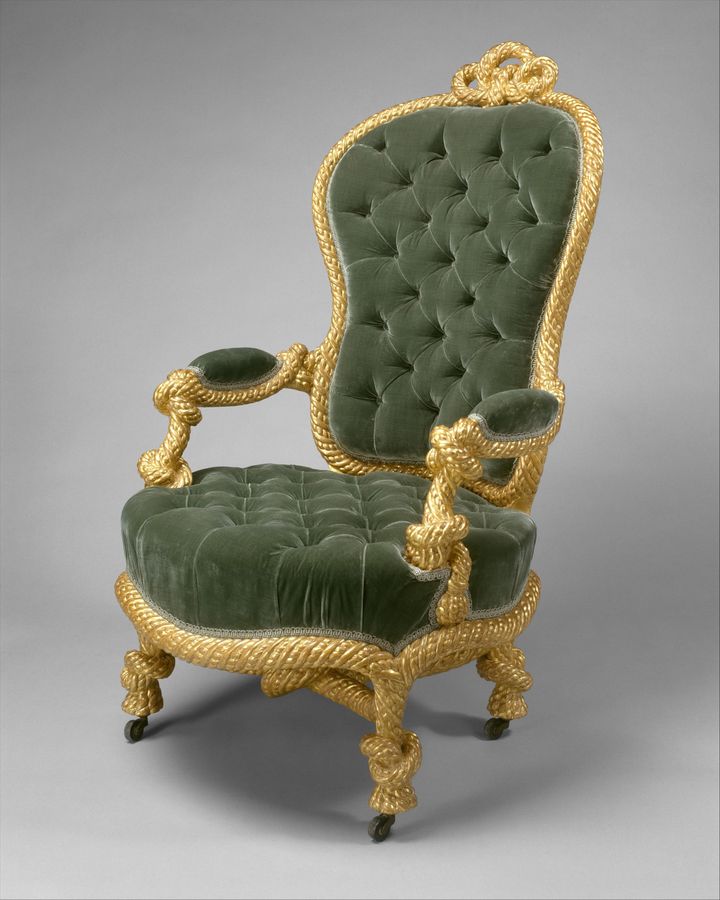
At a glance
The Napoléon III style (1852 to 1870) is the style of eclecticism: it reinterprets every past style (neo-Renaissance, the neo-Louis XVI so dear to Empress Eugénie, neo-Boulle) and invents modern comfort with buttoned, upholstered seating. Ebonised wood, brass, mother-of-pearl and papier-mâché are its hallmarks.
- Period
- 1852 – 1870
- Line
- Eclectic
- Ornament
- Brass, mother-of-pearl, buttoned upholstery
- Woods
- Ebonised pearwood, rosewood
Context
The Industrial Revolution and a newly prosperous bourgeoisie transformed the furniture market. Machines made series production possible, while the great luxury cabinetmakers showed virtuoso pieces at the Expositions Universelles of 1855 and 1867. Empress Eugénie brought the Marie-Antoinette taste back into fashion.
Timeline
- 1852Proclamation of the Second Empire.
- 1853Marriage of Napoléon III and Eugénie de Montijo.
- 1855Paris Exposition Universelle.
- 1867Second Paris Exposition Universelle.
- 1870Fall of the Second Empire.
How to recognise the Napoléon III style
- Ebonised wood — stained pear or beech, inlaid with brass, mother-of-pearl or tortoiseshell.
- Reinterpretation of earlier styles — Boulle, Louis XV, Louis XVI, Renaissance.
- Fully buttoned seating — sprung: crapaud, pouf, confident, indiscret.
- Papier-mâché — black-lacquered and inlaid with mother-of-pearl.
- Lavish gilt-bronze mounts — porcelain and painted plaques.
- Signs of machine production — regular saw marks and industrial screws, even on fine pieces.
Signature pieces: crapaud armchair, confidante, indiscret, pouf, bonheur-du-jour, side cabinet, games table, Neo-Renaissance cabinet.
The Napoléon III style and its neighbours
| Feature | Restauration | Napoléon III | Art Nouveau |
|---|---|---|---|
| Period | 1815 – 1830 | 1852 – 1870 | 1890 – 1914 |
| Line | Softened, rounded | Eclectic | Curving, plant-inspired |
| Legs | Hocked or scroll legs | All styles, castors | Straight-grained and burr |
| Ornament | Inlaid rosettes and palmettes | Brass, mother-of-pearl, buttoned upholstery | Umbels, water lilies, insects |
| Woods | Maple, lemonwood, ash | Ebonised pearwood, rosewood | Walnut, mahogany, fruitwoods |
A Napoléon III piece 'in the Louis XVI style' betrays itself through machine work (even saw cuts, industrial screws, perfectly identical dovetailed drawers) and through mounts that are often less crisply chased. The finest pieces from the luxury workshops (Beurdeley, Fourdinois) are nonetheless of remarkable quality and much sought after.
The Great Names
- Henri-Auguste Fourdinois (1830 – 1907), luxury cabinetmaking of the highest order.
- Charles-Guillaume Diehl (1811 – 1885), cabinetmaker and maker of fine boxes and small luxury wares.
- Guillaume Grohé (1808 – 1885), cabinetmaker to the Empress.
- Alfred Beurdeley (1847 – 1919), copies and reinterpretations of 18th-century furniture.
Frequently asked questions
What is a crapaud armchair?
Is Napoléon III furniture valuable?
Sources: Guillaume Janneau, Les Styles du meuble français, PUF, 'Que sais-je ?' series · Musée des Arts décoratifs, Paris — permanent collections · Musée d'Orsay, decorative arts collections · Musée de l'École de Nancy.