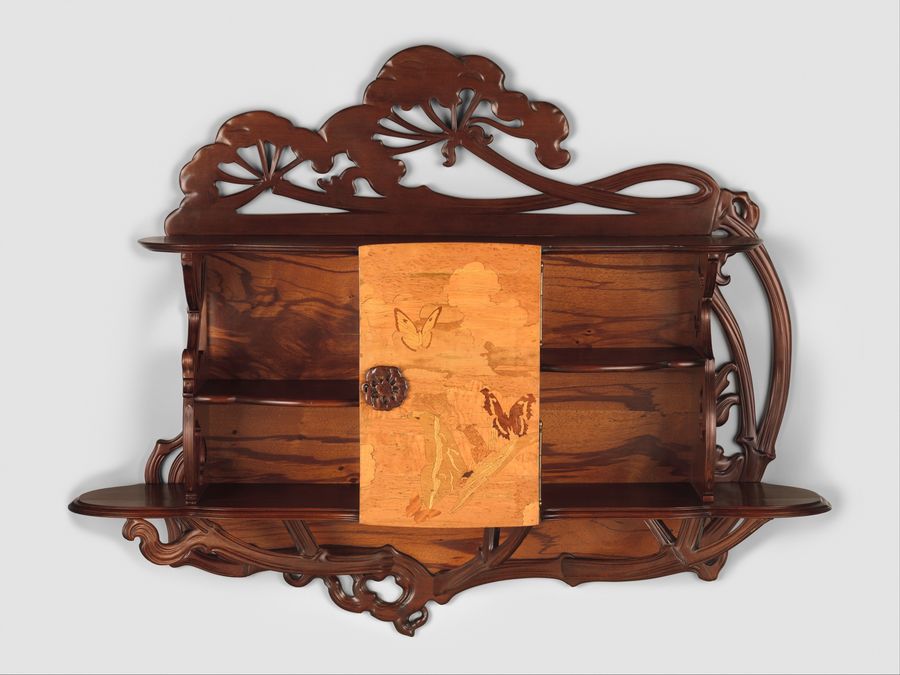
At a glance
Art Nouveau (c. 1890 to 1914) broke with the imitation of historical styles and turned to nature for inspiration: sinuous 'whiplash' lines, plant motifs (umbels, water lilies, orchids) and insects. In France it flourished in Nancy around Émile Gallé and Louis Majorelle, and in Paris with Hector Guimard.
- Period
- 1890 – 1914
- Line
- Curving, plant-inspired
- Ornament
- Umbels, water lilies, insects
- Woods
- Walnut, mahogany, fruitwoods
Context
In the late 19th century, European artists rejected eclecticism in favour of a 'new art' grounded in the observation of nature and the unity of the arts. The dealer Siegfried Bing gave the movement its name when he opened his Paris gallery 'L'Art Nouveau' in 1895. In Nancy, Gallé united glassmakers, cabinetmakers and ironworkers within the École de Nancy.
Timeline
- 1895Siegfried Bing opens the 'L'Art Nouveau' gallery in Paris.
- 1900Exposition Universelle in Paris; Guimard's first Métro entrances.
- 1901Founding of the École de Nancy, with Émile Gallé as president.
- 1904Death of Émile Gallé.
- 1914The war brings the movement to an end.
Recognising Art Nouveau
- Curving, asymmetrical lines — inspired by stems, roots and flowers.
- Naturalistic marquetry — flowers, landscapes, dragonflies, often accompanied by mottoes.
- Plant-form bronzes and mounts — shaped as stems, leaves and water lilies.
- Acid-etched glass — multi-layered, by Gallé and Daum.
- Unified decoration — the artist often designed the entire interior.
- Common signatures — marquetry signed Gallé, L. Majorelle stamp.
Signature pieces: vitrine, plant stand, guéridon, complete dining-room suite, cameo glass vase and lamp, plique-à-jour enamel jewellery.
Art Nouveau and its neighbours
| Feature | Napoléon III | Art Nouveau | Art Deco |
|---|---|---|---|
| Period | 1852 – 1870 | 1890 – 1914 | 1920 – 1940 |
| Line | Eclectic | Curving, plant-inspired | Geometric, streamlined |
| Legs | All styles, castors | Straight-grained and burr | Tapered legs or solid plinths |
| Ornament | Brass, mother-of-pearl, buttoned upholstery | Umbels, water lilies, insects | Chevrons, flower baskets, sunbursts |
| Woods | Ebonised pearwood, rosewood | Walnut, mahogany, fruitwoods | Macassar ebony, rosewood, amboyna |
Art Nouveau differs from its successor, Art Deco, through its curves and naturalism, whereas Art Deco favours geometry and stylisation. Caution: Gallé and Daum glass has been widely copied in modern times; the etching, weight and signature should be examined by a specialist.
The Great Names
- Émile Gallé (1846 – 1904), glassmaker, cabinetmaker and founder of the École de Nancy.
- Louis Majorelle (1859 – 1926), cabinetmaker and ironworker in Nancy.
- Hector Guimard (1867 – 1942), architect of the Paris Métro entrances.
- Eugène Gaillard (1862 – 1933), cabinetmaker for Bing's pavilion at the 1900 Exposition.
Frequently asked questions
What is the École de Nancy?
How can you tell a genuine Gallé vase?
Sources: Guillaume Janneau, Les Styles du meuble français, PUF, 'Que sais-je ?' series · Musée des Arts décoratifs, Paris — permanent collections · Musée d'Orsay, decorative arts collections · Musée de l'École de Nancy.