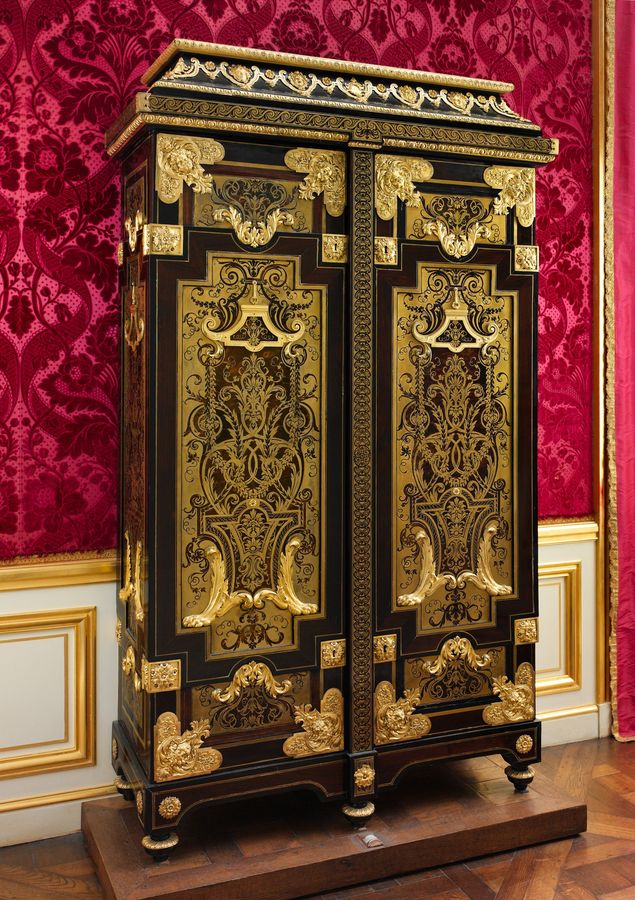
At a glance: André-Charles Boulle (1642–1732) is the most celebrated cabinetmaker of the reign of Louis XIV. Appointed cabinetmaker to the king in 1672 and lodged in the galleries of the Louvre, he perfected the tortoiseshell and metal marquetry that now bears his name. His furniture, of unrivalled richness, was copied well into the 19th century.
Biography
The son of an ebony joiner, Boulle was at once cabinetmaker, chaser, gilder and marquetry craftsman, which allowed him to design both his furniture and its mounts. Lodged at the Louvre, he was exempt from guild rules and worked for the king, the royal family and the great figures of the court.
In 1720 a fire destroyed his workshop, together with his models and stocks of timber. His sons carried on the business. ‘Boulle’ marquetry later enjoyed several revivals, under Louis XVI and again under Napoléon III.
Identifying a piece
- Marquetry of tortoiseshell and brass, sometimes pewter, in ‘première partie’ or ‘contre-partie’.
- Boldly chased gilt-bronze mounts: masks, mascarons, foliage.
- Monumental, symmetrical forms of the Louis XIV style.
- No stamp: attribution rests on archival records and comparison.
Where to see his work
Musée du Louvre, Palace of Versailles, Wallace Collection (London), J. Paul Getty Museum (Los Angeles).
Sources: Guillaume Janneau, Les Styles du meuble français, PUF, ‘Que sais-je ?’ series · Musée des Arts Décoratifs, Paris — permanent collections · collections of the museums cited.