At a glance
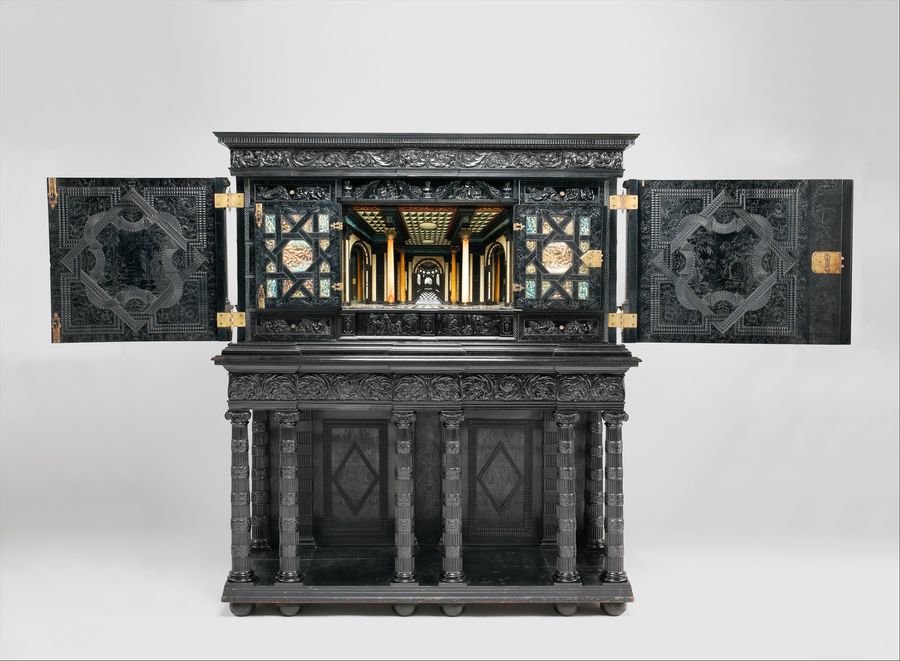
The Louis XIII style (c. 1610 to 1660) marks the birth of modern French furniture: massive, rectilinear forms, turned wood in bobbin, baluster or barley-twist patterns, and legs joined by stretchers. The menuisiers en ébène who veneered cabinets in precious woods at the time gave rise to the word ‘ébéniste’.
- Period
- 1610 – 1660
- Line
- Straight, massive
- Ornament
- Turning, diamond-point carving
- Woods
- Walnut, oak, ebony
Context
Under Henri IV and then Louis XIII, French furniture remained strongly influenced by Italy and Flanders. As the court gradually ceased to travel, furniture, once designed to be carried from place to place, grew larger. In Paris, craftsmen trained in Antwerp veneered cabinets fitted with numerous drawers in ebony: they were called ‘menuisiers en ébène’, and later ébénistes. The style endured long after the king’s death, through the regency of Anne of Austria and Mazarin’s ministry.
Timeline
- 1610Assassination of Henri IV; regency of Marie de Médicis for the young Louis XIII.
- c. 1620First Parisian ebony cabinets, modelled on those of Antwerp.
- 1643Death of Louis XIII; regency of Anne of Austria and ministry of Mazarin.
- 1661Louis XIV begins his personal rule: the style evolves towards the splendour of Versailles.
Recognising the Louis XIII Style
- Turned legs — bobbin, baluster, olive or barley-twist.
- Stretchers — H- or X-shaped, linking the legs and often turned as well.
- Heavy, rectilinear forms — with sharp angles.
- Carved panels — with diamond points, geometric motifs or cartouches.
- Tall, straight-backed seats — upholstered in leather or tapestry secured with nails.
- Ebony cabinets — on stands, with two doors opening onto numerous drawers.
- Few or no bronze mounts — decoration is carved directly into the wood.
Signature pieces: ebony cabinet, table with turned legs, chair with arms (forerunner of the armchair), coffer, two-part buffet, four-poster bed.
Louis XIII and Neighbouring Styles
| Feature | Louis XIII | Louis XIV |
|---|---|---|
| Period | 1610 – 1660 | 1660 – 1715 |
| Line | Straight, massive | Symmetrical, monumental |
| Legs | Turned, joined by stretchers | Baluster, tapering gaine |
| Ornament | Turning, diamond-point carving | Sunburst, acanthus, mascarons |
| Woods | Walnut, oak, ebony | Giltwood, ebony, tortoiseshell |
More restrained than Renaissance furniture, with its profusion of carving, Louis XIII differs from Louis XIV in its lack of gilding, Boulle marquetry and bronze mounts. Beware: the ‘Louis XIII style’ was copied on a massive scale in the 19th and 20th centuries, and provincial production continued well into the 18th century. Period pieces remain rare.
The Great Names
- Jean Macé (c. 1602 – 1672), menuisier en ébène trained in the Low Countries, granted lodgings in the galleries of the Louvre.
Frequently asked questions
Where does the word ‘ébéniste’ come from?
How can you recognise a period Louis XIII chair?
Is Louis XIII furniture rare?
Sources: Guillaume Janneau, Les Styles du meuble français, PUF, ‘Que sais-je?’ series · Musée des Arts décoratifs, Paris — permanent collections · Musée du Louvre, Department of Decorative Arts · Mobilier national.